
The short answer
In crystal practice, the left hand receives and the right hand gives out and protects. So a stone you wear to draw something towards you, such as love, calm, abundance or confidence, goes on the left wrist. A stone you wear to shield yourself, or to help you let go of something, goes on the right.
This is the convention behind every usage line in our crystal knowledge base, and it is shared by Western crystal practice and Chinese tradition alike. It is a tradition rather than a law of nature, but it gives each bracelet a clear purpose, and that clarity is much of the point.
Why left receives and right releases
The idea is that energy flows through the body in one direction: in through the left, out through the right. Chinese tradition puts it in four characters, 左进右出 (zuǒ jìn yòu chū), “left in, right out”. It is why a pixiu bracelet, the wealth guardian said to swallow treasure and never let it go, is traditionally worn on the left, and why a jade bangle is worn on the left wrist to receive good energy. Our Jade and Zodiac compendium explains both.
Western crystal practice reaches the same place by a different road: the left side is thought of as receptive and intuitive, the right as active and outward-facing.
There is a practical reason too. Most people are right-handed, so a bracelet on the left wrist is knocked less, splashed less and lasts longer. If you are left-handed, some practitioners suggest swapping sides so that your dominant hand is always the giving one; others keep the left for receiving regardless. Choose one approach and stay with it.
Crystals for the left wrist
Wear these on the left when you want to welcome something in:
- Love and harmony: rose quartz, moonstone, morganite, strawberry quartz and pink opal.
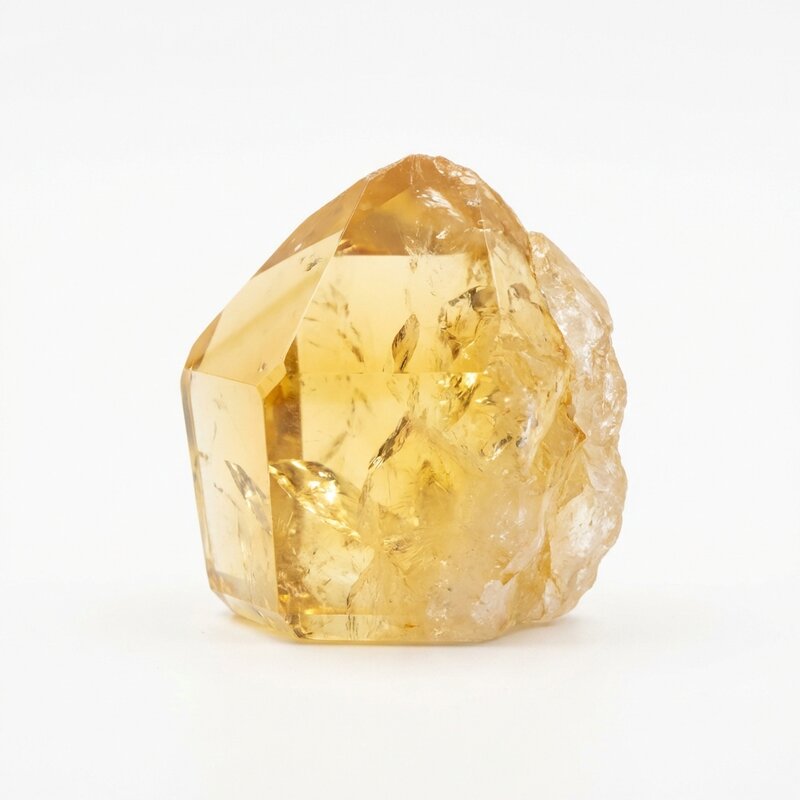
- Wealth and career: citrine, green aventurine, green phantom quartz and iolite.
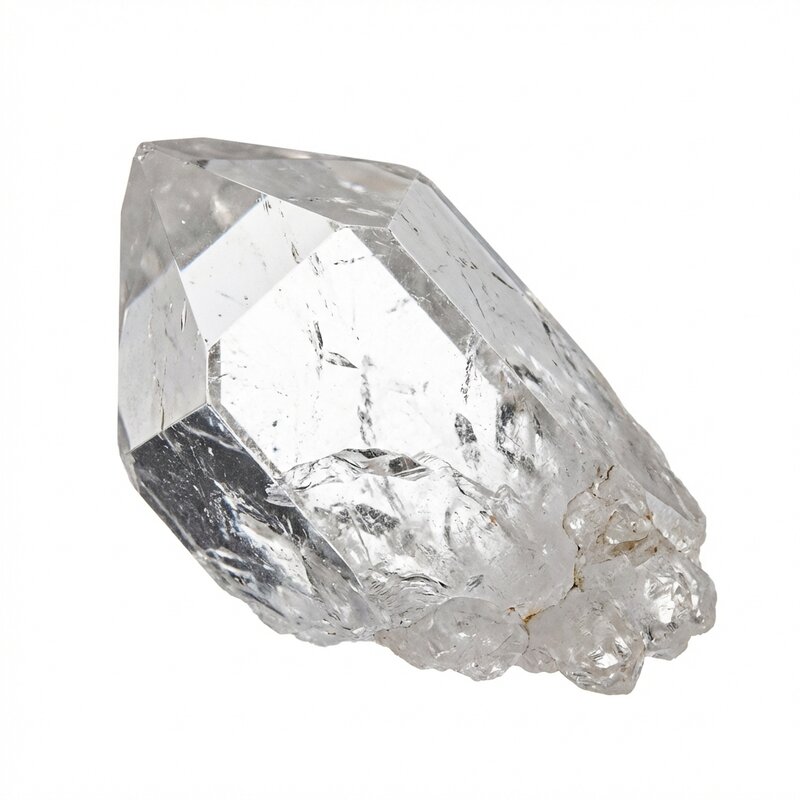
- Calm, focus and rest: amethyst, clear quartz, blue apatite and lepidolite.
- Energy and creativity: carnelian, garnet and red spinel.
- At work: amazonite, prehnite and lapis lazuli.
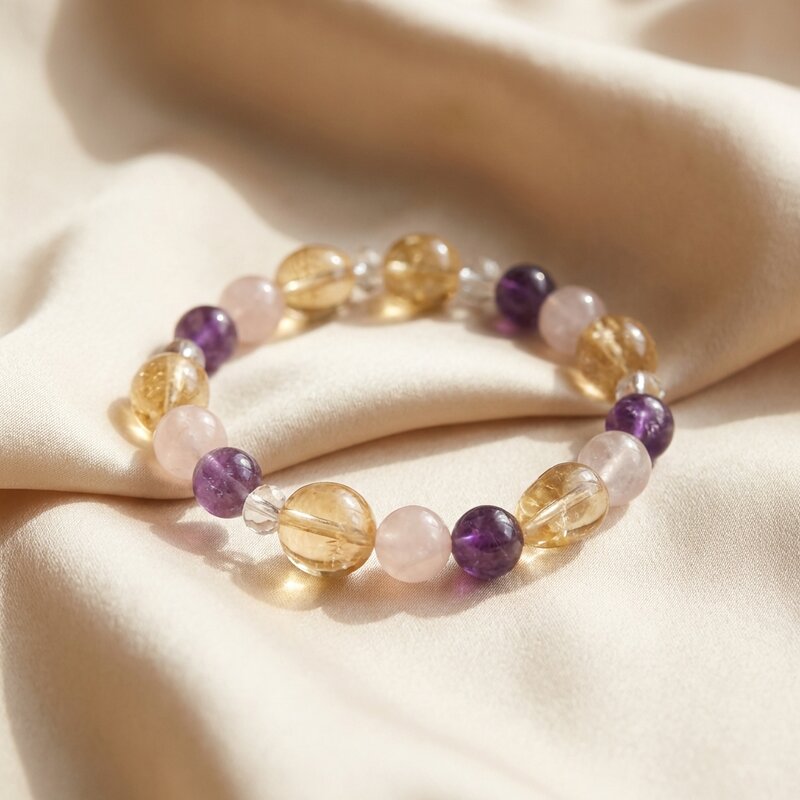
So a strand of amethyst, or a mixed bracelet of citrine and pink quartz, belongs on the left.
Crystals for the right wrist
The right wrist is for protection, grounding and letting go. These stones are traditionally worn there:
- Black tourmaline, said to act as a bodyguard that repels negative energy.
- Black obsidian, said to absorb negativity from your surroundings. Cleanse it often.
- Bronzite, for days when you have to face difficult people.
- Larvikite, for grounding.
- Pietersite, for staying calm when everything around you is stormy.
Malachite and smoky quartz, traditionally worn for protection and grounding, follow the same logic: on the right wrist, a bracelet is said to form a boundary between you and the world.
The stones that change sides
A few stones move depending on what you ask of them. Tiger’s eye is the clearest example: wear it on the left for confidence, on the right for protection. It is a good companion for a new job or a tough negotiation, when you need a little of both.
Labradorite is a protective stone, yet it is worn on the left. The reason lies in its nickname, the Shield of Light: rather than pushing things away, it is said to keep your own energy from leaking out, so it sits on the receiving side. Mixed bracelets made for balance, such as a chakra strand with one stone for each energy centre, can be worn on either wrist.
Some stones are not meant for the wrist at all. Rhodochrosite and dioptase are traditionally worn over the heart, while aquamarine and sodalite are worn as necklaces, close to the throat.
Wearing more than one bracelet
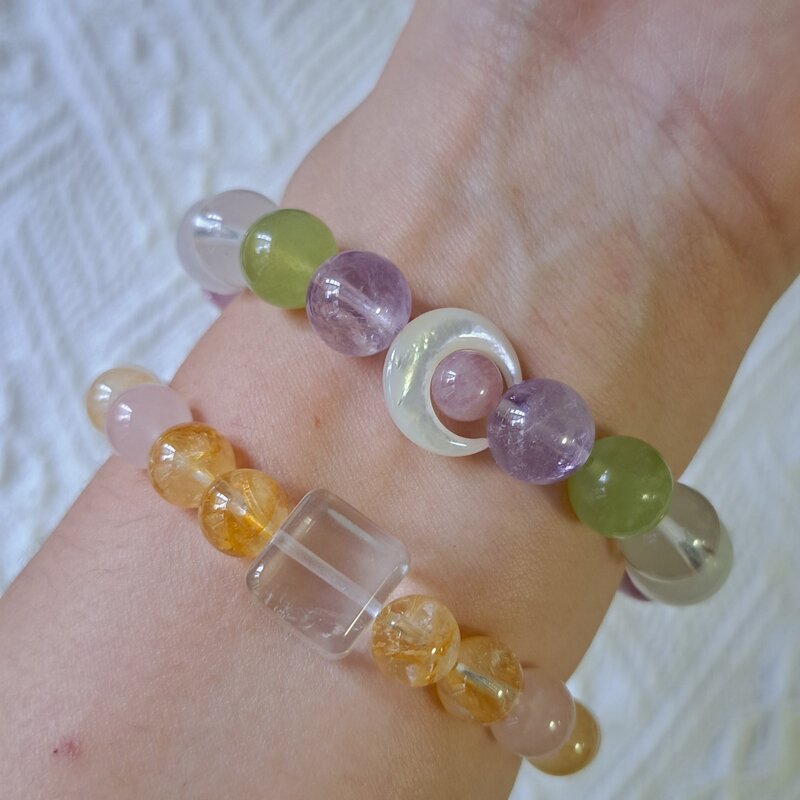
Stacking is fine, and often lovely. The simplest rule is to keep each wrist to one direction: receiving stones together on the left, protective stones together on the right. A popular pairing is black tourmaline on the right with citrine or rose quartz on the left, protected on one side and open on the other.
- Two or three per wrist is plenty. Beyond that, the intentions start to blur and the beads rub against one another.
- Clear quartz is a generous partner. In crystal lore it amplifies the stones around it, so it sits happily beside almost anything.
- Mind the hardness. Quartz-family beads, at 7 on the Mohs scale, can scratch softer stones such as malachite or turquoise when they are worn tightly together.
What about your watch?
Many people wear a watch on the left wrist, which is also where receiving stones go. You have three good options:
- Wear both on the left, with the bracelet a little further up the arm. Beads that keep knocking against a watch case can chip, and quartz beads can scratch a mineral-glass watch face.
- Move the watch to the right if you wear your receiving stones every day. It takes about a week to feel natural.
- Keep the watch on the left and wear a protective bracelet on the right. This works well if protection or grounding is your main intention anyway.
A smartwatch sensor needs close contact with the skin, and a bracelet pressed against it can get in the way. Give the bracelet the other wrist, or wear it higher up.
Make it a small daily ritual
Whichever wrist you choose, the moment you put the bracelet on is a good time to set your intention for the day: one quiet sentence about what you would like the stone to hold for you. Refresh your stones now and then, as our guide to cleansing crystals explains, and take bracelets off before swimming or showering so the elastic lasts in Singapore’s humidity. Still deciding where to begin? Read how to choose your first crystal bracelet, or join us live to see bracelets up close and ask which wrist suits each stone.
Crystal meanings and feng shui are shared from tradition for reflection and enjoyment; they are not a substitute for medical, financial or professional advice.