Follow one piece of jade from a weathered boulder to the carved pendant you wear, and the eight-thousand-year craft behind it.
4 min readBy L'Claire
Scroll
I原石
The Stone
Jade begins as a boulder. Most gem jadeite comes from around Hpakant in northern Myanmar, where it is dug from old river gravels with its colour hidden beneath a weathered skin, often stained brown and ochre by iron. From the outside, a fortune and an ordinary rock can look much the same.
So the trade reads the skin, and then grinds a small window, 开窗, to look inside. Under a torch, a buyer judges the colour and the glow coming through that patch, and bids. Everyone knows it is a gamble. In Chinese the whole trade in rough jade is called stone gambling, 赌石, and an old saying warns that even an immortal cannot judge an inch of jade, 神仙难断寸玉. The window shows only the window. The rest of the boulder may hold the same green, or none at all.
II开料
The Cut
The boulder is opened with a saw whose blade is edged with diamond. It does not slice so much as grind its way through, slowly, under a constant stream of water. The water carries away the heat of friction, which could otherwise crack the stone, and keeps the blade from wearing out.
This is the moment of truth. The trade has a blunt phrase for it: one cut to poverty, one cut to riches, 一刀穷,一刀富. A green that glowed in the window may run right through the stone, or stop a finger’s width beneath the skin. That is why cutters study a boulder for a long time before they choose where the first cut will fall.
III取料
The Slab
With the stone open, the carver’s real work begins, and it begins with looking. Chinese jade carving has a principle for it, 因材施艺: let the material decide the design. The carver traces the colour, follows the grain and searches for cracks, which no finished piece can afford, then marks out the cleanest slab.
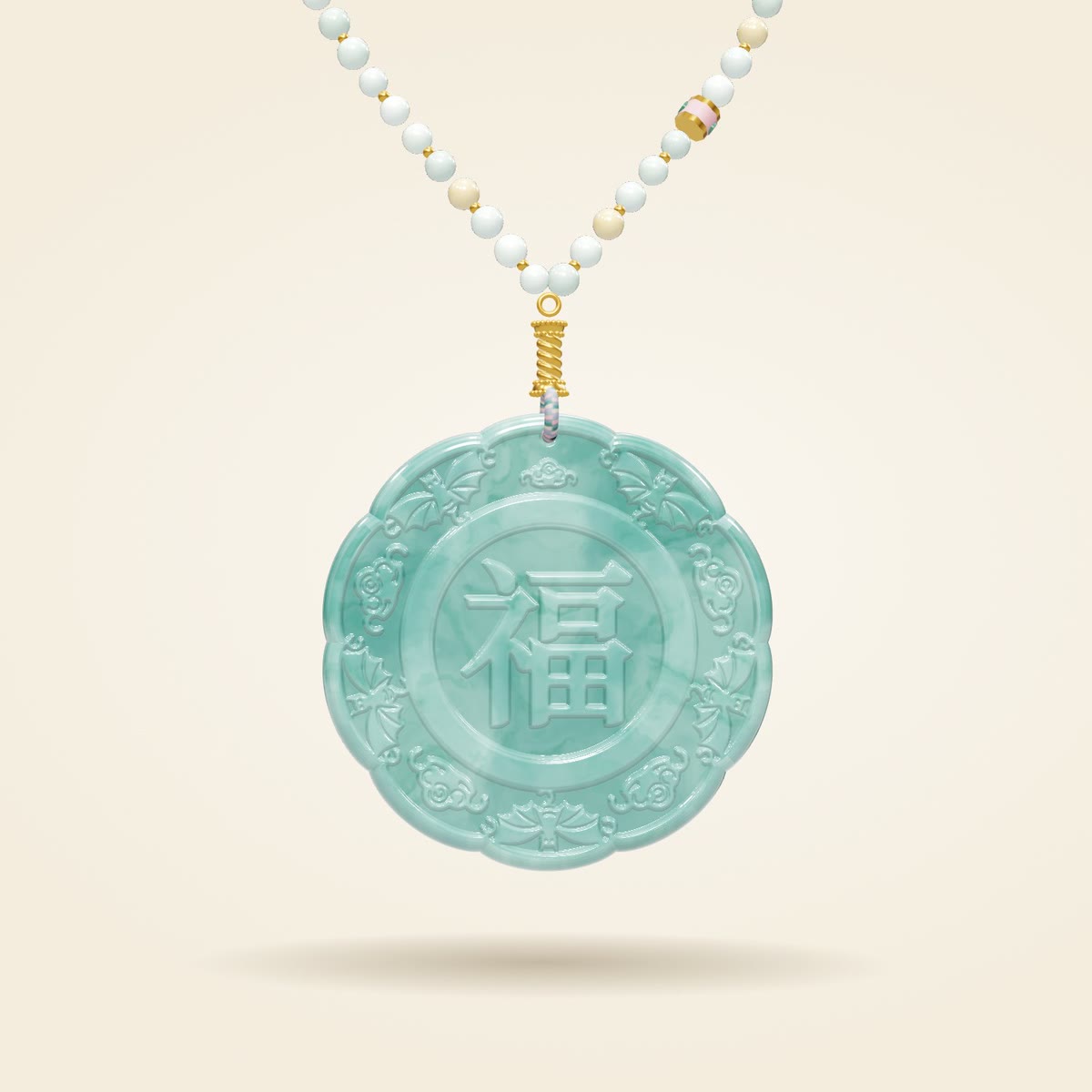
Nothing is wasted without thought. A patch of the brown skin might become the wing of a bird or the shell of a gourd. This art of using a stone’s own colours, 俏色 (qiàosè), is one of the most admired skills in jade carving, and a small flaw can disappear into the fold of a carved leaf. Here, a single clear slab is cut for a round pendant, with the colour centred where the eye will fall.
IV成形
The Form
The slab is ground into a round blank and its rim shaped into soft, scalloped petals. Even now, with electric tools, this is grinding rather than cutting. Bronze and iron cannot cut jade, so for thousands of years carvers worked it with abrasives harder than the stone, such as quartz sand, crushed garnet and corundum, mixed with water into a slurry and fed to a turning wheel or drill. The wheel never cut the jade. The grit beneath it did.
Today the grit is diamond, bonded to the tool, and water still runs over the stone at almost every stage. The round shape is an old favourite. It echoes the bi discs of ancient China and the Ping An Kou 平安扣, the disc still worn today as a wish for safety.
V雕刻
The Carving
The design is drawn onto the stone and carved in relief, the background ground away so that the figures stand proud. At the centre is 福 (fú): good fortune, blessing, one of the most loved characters in Chinese life. Around it, bats and auspicious clouds.
The bats are a pun, and a very old one. The word for bat, 蝠, is also pronounced fú, so a bat carved on jade is a blessing written in pictures. Five bats together stand for the Five Blessings: a long life, wealth, health, a love of virtue and a peaceful end. Reading this quiet language is half the pleasure of carved jade.
Modern carvers work with fine diamond burrs on a spinning shaft, moving to smaller and smaller tips for the detail. Before electric tools, the same lines were ground with small wheels called 砣 (tuó), fed by hand with wet abrasive.
VI抛光
The Polish
A carved piece comes off the tools with a dull, frosted surface, its colour still asleep. Polishing wakes it. The jade is worked with finer and finer abrasives, each stage removing the marks of the one before, into every hollow and around every edge of the carving.
This is when jade shows the quality the trade values most, its water, 水头 (shuǐtóu): how deeply light seems to travel into the stone. Fine jadeite is often finished with a thin coat of colourless wax, a traditional part of polishing rather than a treatment. What matters is what lies beneath. Jadeite that has not been bleached, filled with resin or dyed is called Type A, the jade families keep for generations. Our jade buying guide explains the grades.
VII成品
The Blessing
Finally the pendant is fitted with a bail and strung with jade beads and touches of gold, and the stone that began as a gamble becomes a gift. In China jade has always been for giving: a first pendant for a newborn, a bangle for a bride, a blessing for an elder’s birthday.
The Book of Rites holds the whole journey in six characters: 玉不琢,不成器, jade that is not carved does not become a vessel. It was written about people, not stones, as a reminder that we too are shaped by learning and patience. A carved jade pendant carries both: thousands of years of craft, and the long, careful work of the hands that made it.
Jade lore and symbolism are shared from tradition for reflection and enjoyment; they are not a substitute for professional advice. The pendant in this story is an illustration.
Jade is made of tightly interlocking crystals, which makes it exceptionally tough, and bronze and iron tools cannot cut it. It is shaped by abrasion instead, with grit harder than the stone. Today that grit is diamond.
What is stone gambling?
Stone gambling, 赌石, is buying rough jade by its skin and a small polished window without knowing what lies inside. The colour seen in the window may not continue through the boulder, so the buyer takes a real risk.
What does 福 on a jade pendant mean?
福 (fú) means good fortune or blessing. Bats are often carved around it because the word for bat is also pronounced fú, so the design repeats the same wish in pictures.
Is polished jade treated?
Not necessarily. Polishing and a thin coat of colourless wax are part of normal finishing. Bleaching, resin filling and dyeing are treatments and should always be disclosed, so ask whether a piece is Type A.